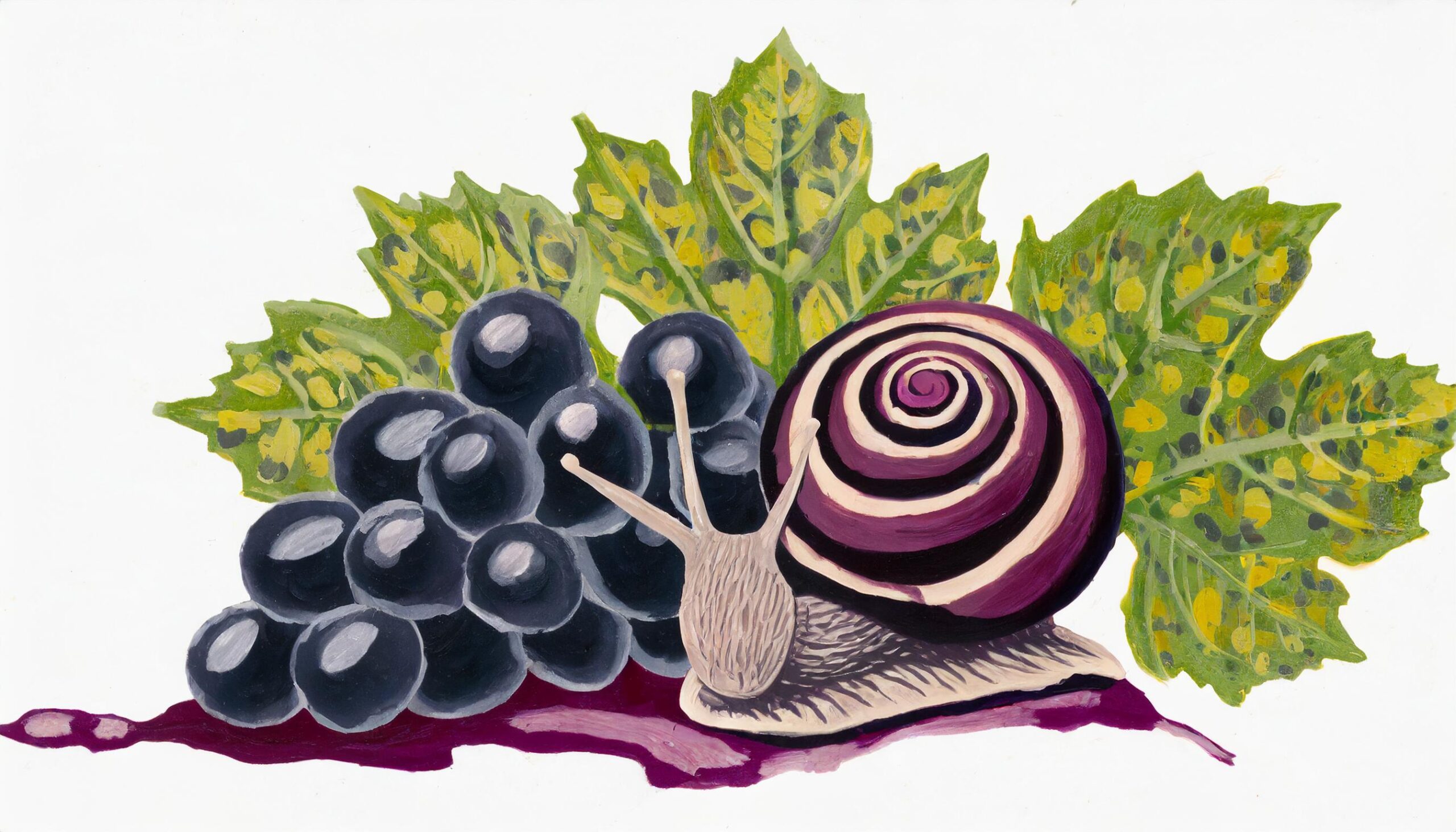

2024 will be known as the year of the snail.
If you didn’t notice the rows of vines as you approached our vineyards this year, you would be convinced that you had happened upon a snail farm. At picking time, it was inevitable that hundreds of them wound up in the picking bins, and we hunched over the bins as we always do, picking out leaves and stems, and this time around, a myriad of gastropods.
What can I say about organic farming? Sometimes certain critters decide that they are in the right place, and we just have to deal with it. The growing season was unusually cold and damp, with very few heat waves, and the snails found a happy home. Who am I to disturb their pleasant, albeit slow, progress across the canopy?
“Never doubt the courage of the French. They were the ones who discovered that snails are edible.” – Doug Larson
In ancient Greece, snails represented fertility and the fruition of hard work. The Aztecs refer to snails as representing cycles of the universe and reincarnation. Japanese culture considers snails the most fertile of beings and the gods of water, while across the African continent, snails take on a variety of meanings from symbols of the creation of man to eternal life.
As has become happenstance with this strange vineyard, the experts all said that they had never seen this before. When I mentioned it to one of my workers, he shrugged his shoulders, “I have never heard of snails becoming a problem in a vineyard.” As the year progressed and the snails became ever more plentiful, I decided to take it as a good omen, much like the Greeks, the Aztecs, Africans, or the Japanese. A bountiful harvest will be mine, I told myself.
For the most part, that was what occurred. The fruit was healthy and in balance, and if we were forced to put a bit more work into sorting snails out of the fruit bins, so be it. The vineyard workers all joked if I was going to make a sopa de caracol (snail soup, a delicacy in Latin America, although they make it with conch). Just wine, I retorted, although perhaps we would call it Wild King Pinot Noir, Escargot Block.
– Will Henry